Defining “Urban” and “Rural”: How Urban-Rural Boundaries Shape What We Know About Development, especially when “rural” is simply what is not “urban.”
Key Takeaways
- Definitions of “rural” and “urban” can affect indicators of economic development used for decision-making and funding allocations.
- Within countries, periodically re-categorizing households as rural or urban can affect measures of rural poverty and other welfare indicators.
- Across countries, different classifications can vary considerably and limit valid comparisons.
Urban versus Rural Categorization
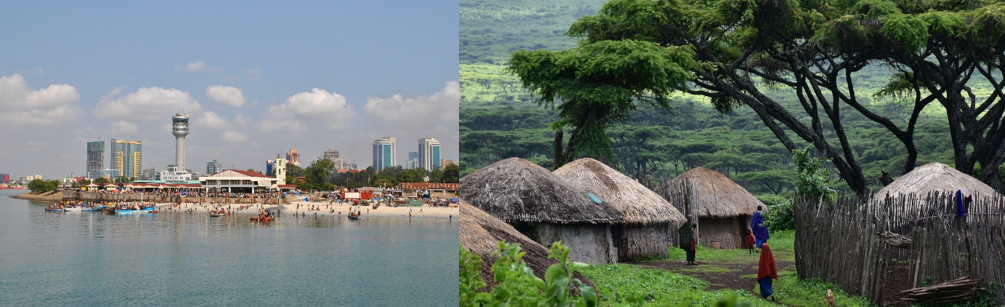
The majority of countries use an administrative definition to distinguish between urban and rural areas based on thresholds of population, density, size, or economic development. But despite urban / rural categorizations commonly being used in agricultural and development analyses, and within global monitoring systems such as the Sustainable Development Goals (SDGs), there is no universal standard.
Almost a decade ago Moreno (2017) noted: Localities in Denmark or Iceland are urban above 200 inhabitants or more, whereas the Netherlands and Nigeria use a threshold of 20,000, Mali 30,000, and Japan 50,000 inhabitants. Some countries use multiple criteria. “For instance, urban areas in Bhutan need to satisfy at least 4 conditions out of 5 criteria: a minimum population (1,500 inhabitants), a threshold in population density (1,000 persons per sq. km), depend on non-primary economic activities (more than 50%), a minimum requirement for the area of the urban center (not less than 1.5 sq. km.), and the need to have economic potential for future growth (revenue base)” (Moreno, 2017, p. 3).
In all countries, urban–rural classifications play a central role in guiding policy interventions and serve as an important stratification variable in data collection. To understand how alternative urban vs. rural categorizations affect development indicators and related policy conclusions, in this blog, we summarize the approach followed in Wineman et. al (2020). We use data from four waves of the nationally representative data from Tanzania and Nigeria, focusing on the Tanzania National Panel Living Standards Measurement Study (TZNPS) from 2008 through 2014 as a case study. This dataset captures rural and urban households based on the country’s administrative definition. We also draw from various secondary data sources such as the 2013 WorldPop data set, 2016 NOAA DMSP-OLS Nighttime Lights Time Series data set, 2017 Global Man-made Impervious (GMIS) data set, 2017 Africapolis data set, and spatial data from Google Earth that have been used across countries and studies to map out urbanization.
Approaches for Defining Urban Areas
Although a country’s administrative definition might be considered the default for measuring “urban” areas, periodic reclassification – usually with a census – that nudges growing rural areas up into the urban category – leaves “rural” as the residual. In many administrative definitions, “Rural” is de facto what is NOT “Urban”. We therefore examine alternative measures of understanding urbanization and rural welfare over time.
| Definition / construction | ||
| 1. | Administrative definition | The official designation in each country |
| 2. | Population density | A household is categorized as urban if the local population density is at least 500 persons/km2 (from WorldPop). |
| 3. | Impervious surface | A household is categorized as urban if the share of impervious surface (man-made surfaces) cover is at least 2% (from the GMIS data set of Landsat). |
| 4. | Night lights intensity | A household is categorized as urban if the intensity of night lights is at least 8 on a scale of 0 to 63 (from the NOAA DMSP-OLS Nighttime Lights Time Series data set). |
| 5. | Africapolis | The designation of urban areas is provided by Africapolis, which bases its determination on the settlement population size (≥ 10,000) and the distance between buildings. |
| 6. | Local economy | A household is categorized as urban if the average share of nonfarm income (excluding crop, livestock, or agricultural wage income) among the nearest 7 neighbors is at least 66%. |
| 7. | Subjective assessment | A household is categorized as urban based on subjective assessment of Google Earth images. This labor-intensive categorization was applied only to the 2014 survey wave. |
Impacts of Choosing Different Definitions of “Urban”
- Cross-country comparisons of urbanization levels are sensitive to definition choice
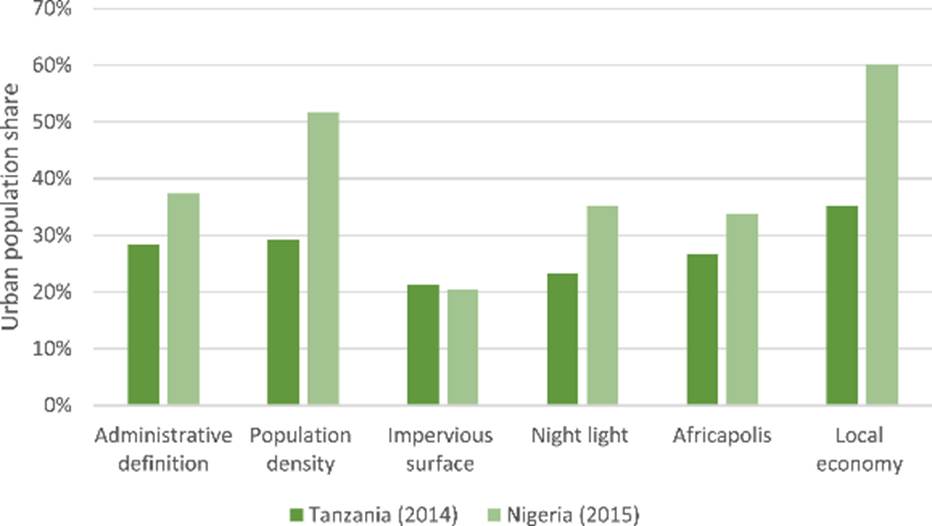
We find that patterns of urbanization levels in Tanzania and Nigeria reverse depending on definition. For example, using the ‘impervious surface’ definition, Tanzania has a slightly larger urban population share than Nigeria. For all other definitions, Tanzania’s urban share is lower than Nigeria.
- Definition choice swings urbanization levels by ~ 20 percentage points
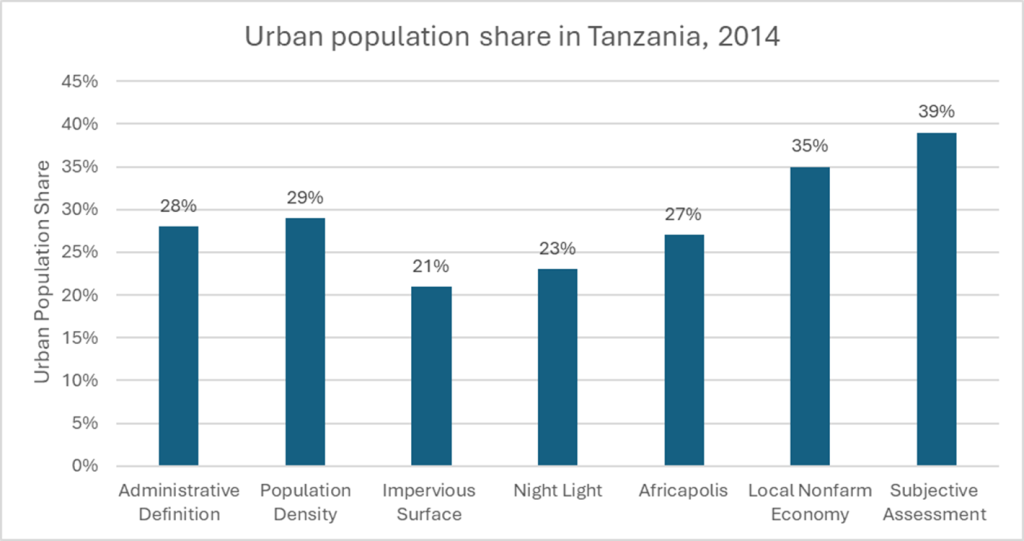
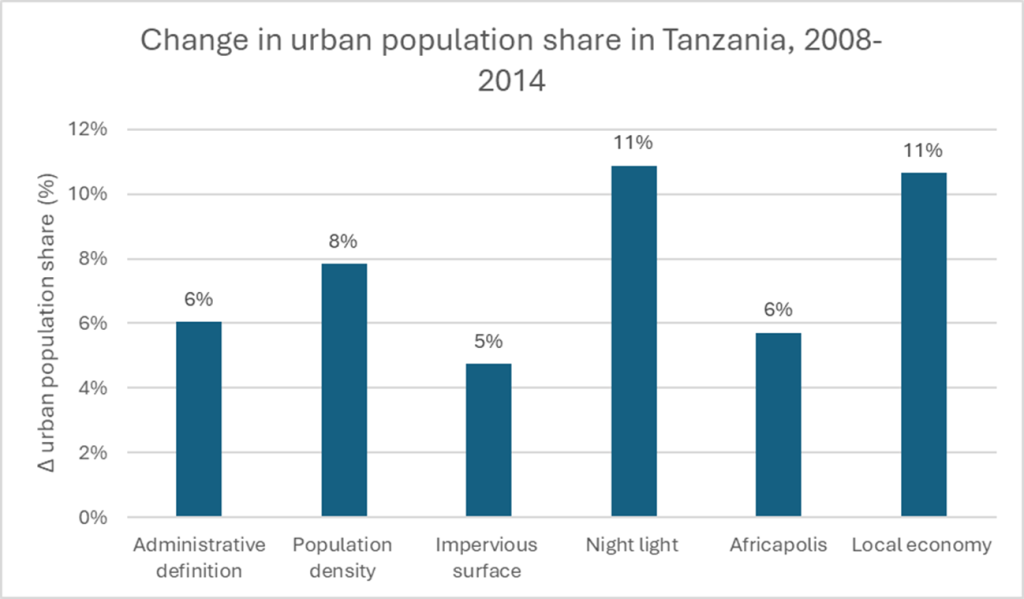
Urbanization represents a shift from a dispersed population toward one that resides in more densely populated settlements with more non-agricultural economic activities. The urbanization ‘level’ is a static point-in-time measure of the urban population share, whereas the urbanization ‘rate’ is the rate of change from a rural to urban area over time. Per official urban/rural designations, in 2014, 28% of the national population of Tanzania was urban. Between 2008 and 2014, the urbanization rate was 6%.
Using seven different definitions (Table 1), we find that urbanization levels ranged from 21% (impervious surface) to 39% (subjective assessment), and that urbanization rates over 2008-14 ranged from 6% (administrative definition) to 11% (night light and local nonfarm economy).
- Who counts as “rural” shapes what we know about rural poverty
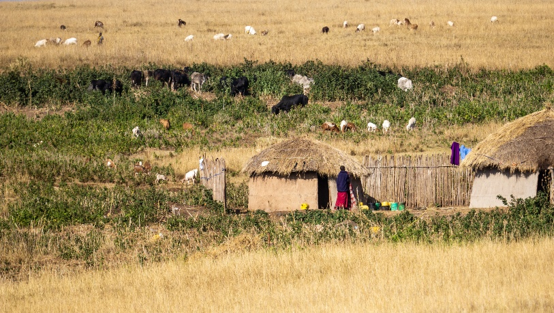
A country’s trajectory along the arc of structural transformation and poverty reduction has traditionally been tied to urbanization, and the economic orientation and rate of agricultural commercialization in rural areas. Our analyses show that the definition of “urban” can affect measures of transformation. For example, the share of the rural population with electricity is estimated to be 3% with a local economy-based definition of urban but is 9% with the night light-based definition.
To unpack this, we compared welfare characteristics of households classified as rural under both the “administrative” and “night light intensity” definitions, to those that switch from their original category with a change in definition. We find that compared to households which were rural under both definitions, those considered rural under the administrative definition but urban per the night light definition were significantly wealthier. The same applies for households considered urban under the administrative definition but rural per the night light definition. These areas that switch classification:
- Have higher consumption and lower poverty rates
- Spend less of their budget on food and access more of their food through purchases
- Are more likely to live in homes with modern roof materials.
Lastly, we explored the income portfolios of rural households, focusing on the household’s farm income, covering the share of crop production, livestock production and agricultural wages. Across three definitions (administrative, night light, local nonfarm economy), we find that the average household income share from crops ranges from 37% – 42%, and the average income share from agricultural sources ranges from 57 – 64%. Using the administrative and night light definitions, we find that rural households are increasingly shifting away from agriculture. However, this trend is not consistent with the local economy definition, under which areas that are less agriculturally focused are recategorized to urban. Thus, “rural” appears to be static – these are, by definition, the areas that are not changing.
- Periodic reclassification can create a false picture of stagnant rural welfare
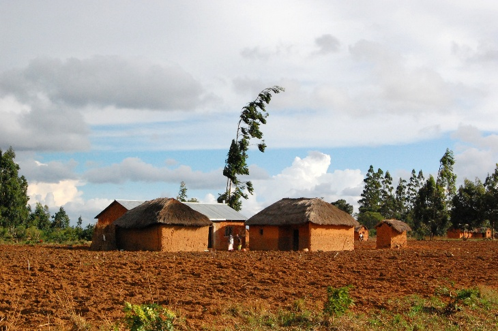
With each census, Tanzania recategorizes rural enumeration areas as urban if the town has a market, school, and/or health center and if the area essentially “feels” urban. Such a recategorization can result in rural poverty staying stagnant by definition, as successful rural areas are re-categorized as urban. Indeed, if we did not allow rural Tanzania to physically shrink over time, poverty declines slightly faster (by one percentage point), the rate of primary school completion increases faster (by one percentage point), and access to electricity increases faster (by two percentage points).
If the goal is to study transformation of the “rural” economy, care is necessary with data that crosses census reclassifications.
Lessons Learned
A 2022 UN Statistical Commission Side event announcement in 2022 noted that in addition to the centrality of urbanization in the SDG framework, it: “was also a call for collection of data at the urban level and/or disaggregation of reporting between urban and rural levels. Generation of data that is comparable at the urban level, however, requires clear definitions on what constitutes a city, as well as globally applicable metrics/ thresholds that can be applied across countries”. Until that time, large differences in official definitions of “rural”, challenge meaningful cross-country comparatives and rural time-series analyses by relegating “rural” as a residual category.
The different criteria underlying official definitions of “urban” and its residual “rural” are important to recognize when they guide country or global budget and resource allocations.
But the reality is that agreed upon and harmonized definitions may never emerge, and most official definitions are only focused on urbanization. The good news is the amount of publicly available tabular and spatial data can supplement national survey data to provide insights on specific questions, particularly those focused on changes in rural populations.
Blog written by: Samantha Petrelli, Vedavati Patwardhan and C. Leigh Anderson.
Based on: Ayala Wineman, Didier Yélognissè Alia, C. Leigh Anderson, Definitions of “rural” and “urban” and understandings of economic transformation: Evidence from Tanzania, Journal of Rural Studies, Volume 79, 2020, Pages 254-268, ISSN 0743-0167, https://doi.org/10.1016/j.jrurstud.2020.08.014. (Available here)
Additional References
Concepts, definitions and data sources for the study of urbanization: the 2030, Agenda for Sustainable Development, Eduardo López Moreno, Head Research and Capacity Development, UN-Habitat, 2017.